What Is Forex?
Ever walked into an airport, saw a currency exchange booth, and thought: “Why does this look like a math exam I never studied for?”
Congratulations — you’ve already met the baby version of the foreign exchange market.
Now imagine that tiny airport booth but supercharged:
- running 24 hours a day, five days a week
- handling trillions of dollars
- with banks, hedge funds, governments, and traders all exchanging currencies at lightning speed
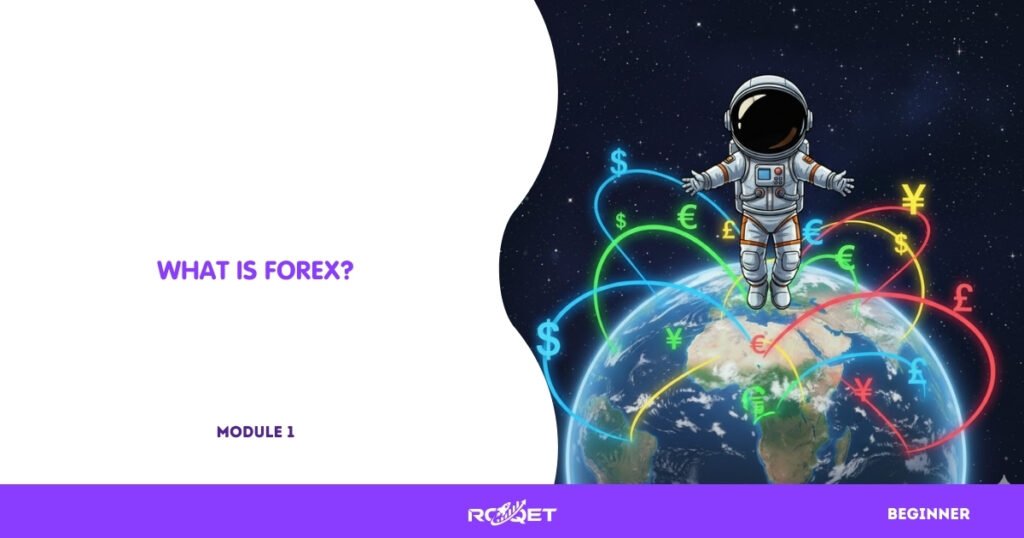
That gigantic global marketplace is Forex — the Foreign Exchange Market, the world’s largest financial market.
Why does Forex even exist?
Because countries trade with each other. Businesses import and export. Travelers buy foreign currencies. Investors move money across borders.
And all of that money movement requires swapping one currency for another — constantly.
👉 This is why Forex exists: the world needs a place to exchange currencies so global economic activity can function.
How Forex Works (The Simple Version)
Let’s keep this beginner-friendly — no charts, no candlesticks, no brokers, no platform tutorials yet.
Forex is basically:
One currency is traded for another, at an agreed-upon exchange rate.
Example:
- If you buy EUR/USD, you’re buying euros while selling U.S. dollars.
- If the euro becomes more valuable compared to the dollar, your euros are worth more dollars than before → profit.
Who trades in Forex?
Way more than retail traders:
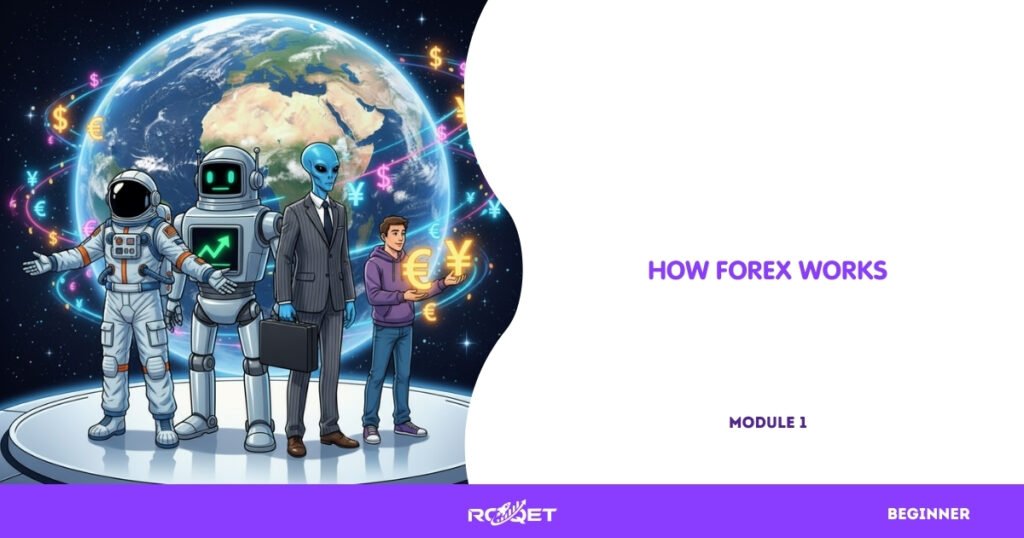
- Banks — the biggest players
- Central banks — influencing national currencies
- Institutions & hedge funds — massive capital flows
- Corporations — paying suppliers overseas
- Retail traders — the small fry (yep, that’s us)
Forex is open 24 hours a day, 5 days a week, because when one financial center closes, another opens:
- London wakes up
- New York takes over
- Asia continues the cycle
This creates a constantly running global money engine.
Why This Matters in Real Trading
Forex isn’t just “charts and candlesticks” (and we’re not touching those yet).
Understanding what the market is forms the foundation for everything you’ll learn later.
Practical Implications
- Traders must understand who moves the market.
Banks and institutions control the majority of volume. - Currency strength affects every trade you’ll ever place.
Forex is a relative market — one currency vs another. - The 24/5 cycle affects volatility.
Some hours are quiet, others are chaotic.
Common Beginner Misunderstandings
- Thinking Forex is a “chart game” instead of a global money system.
- Assuming retail traders control the market (they don’t).
- Believing currencies move randomly — they don’t; they respond to global economic flows.
💡 Tip: Always remember: you’re trading entire economies, not squiggly chart lines.
🤓 Did You Know?: Forex trades over $6 trillion per day, making it bigger than the stock market, crypto market, and bond market combined.
Key Takeaways
- Forex is the global marketplace where currencies are exchanged.
- It exists because countries, businesses, and investors need to move money across borders.
- The market runs 24 hours a day, 5 days a week.
- Major participants include banks, institutions, corporations, and retail traders.
- Understanding the nature of Forex is essential before learning charts, strategies, or platforms.
Leave a Reply